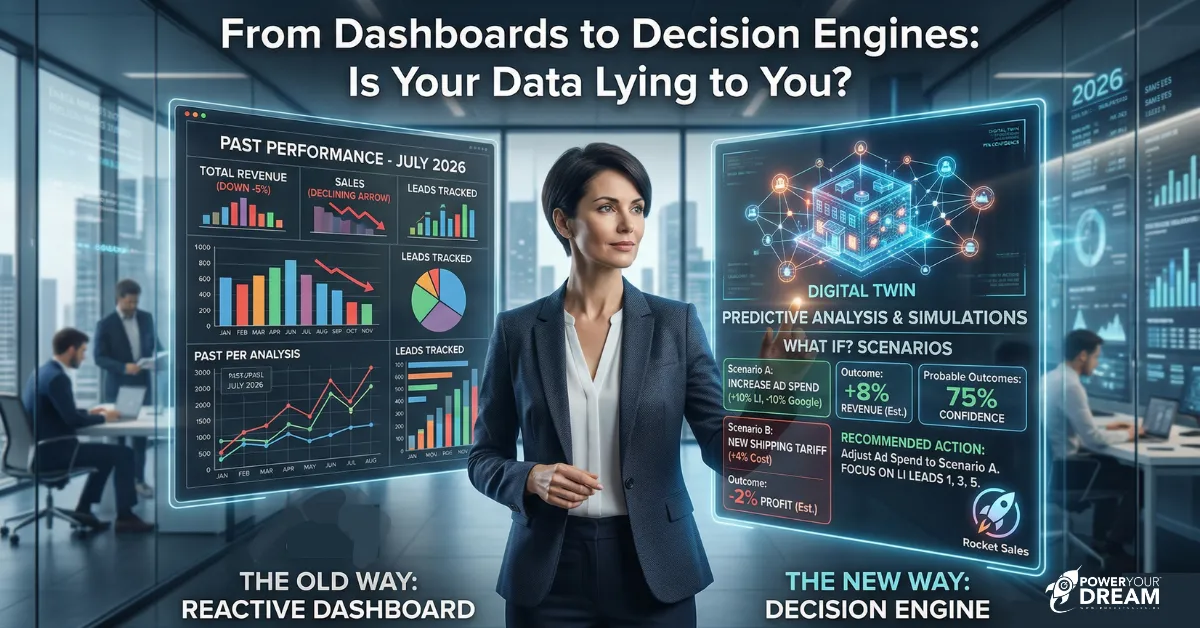
From Dashboards to Decision Engines: Is Your Data Lying to You?
For the last decade, business owners have been obsessed with "Dashboards." We love the charts, the green arrows, and the "Total Revenue" numbers. But as we reach the midpoint of 2026, many owners are realizing a painful truth: A dashboard tells you what happened, but it rarely tells you what to do.
We are entering the era of the "Decision Engine."
The Failure of Reactive Reporting
Traditional dashboards are reactive. They show you that sales were down 5% last month. By the time you see that number, the damage is done. You spend the next month "post-gaming" the failure instead of preventing the next one.
In a fast-moving 2026 economy, looking at last month's data is like driving a car while looking only in the rearview mirror. It’s helpful for context, but it won't help you navigate the turn ahead.
What is a Decision Engine?
A Decision Engine doesn't just display data; it runs simulations. Using "Digital Twins" of your business model, these systems can ask "What if?"
What if we increase our ad spend by 10% on LinkedIn but decrease it on Google?
What if our top salesperson leaves?
What if the new tariff increases our shipping costs by 4%?
Instead of a static chart, you get a series of Probable Outcomes. This allows business owners to make decisions based on the future, not the past.
The End of "Gut Feeling"
We’ve all heard the phrase "I have a gut feeling about this deal." In 2026, "gut feeling" is becoming a liability. While human intuition is still vital for creativity and relationship-building, it is notoriously bad at processing the vast amounts of data generated by modern sales cycles.
A Decision Engine acts as a "Bailiff" for your intuition. It checks your gut feeling against the cold, hard reality of the data. It helps you identify "Ghost Leads"—prospects that look great on paper but have a statistically zero chance of closing based on historical patterns.
How to Build Your Decision Engine
You don't need a team of data scientists to move in this direction.
Identify Your North Star Metrics: Stop tracking 50 different KPIs. Choose the 3 that actually drive your business.
Integrate Your Silos: Your sales data, marketing data, and financial data must live in the same place. A decision engine is only powerful when it sees the whole picture.
Demand "Next Best Action": Don't settle for a software that just shows you a list of leads. Look for software that tells you which lead to call first and why.
The Rocket Sales Approach
Rocket Sales was built on the belief that data should be actionable. Our platform isn't just a place to store names and numbers; it’s a predictive engine designed to find the shortest path to a "Yes."
In 2026, the business owners who thrive won't be the ones with the most data. They will be the ones who know how to use that data to make better decisions, faster. Stop looking at your dashboard and start looking at your future. Visit us at: https://rocketsales.us