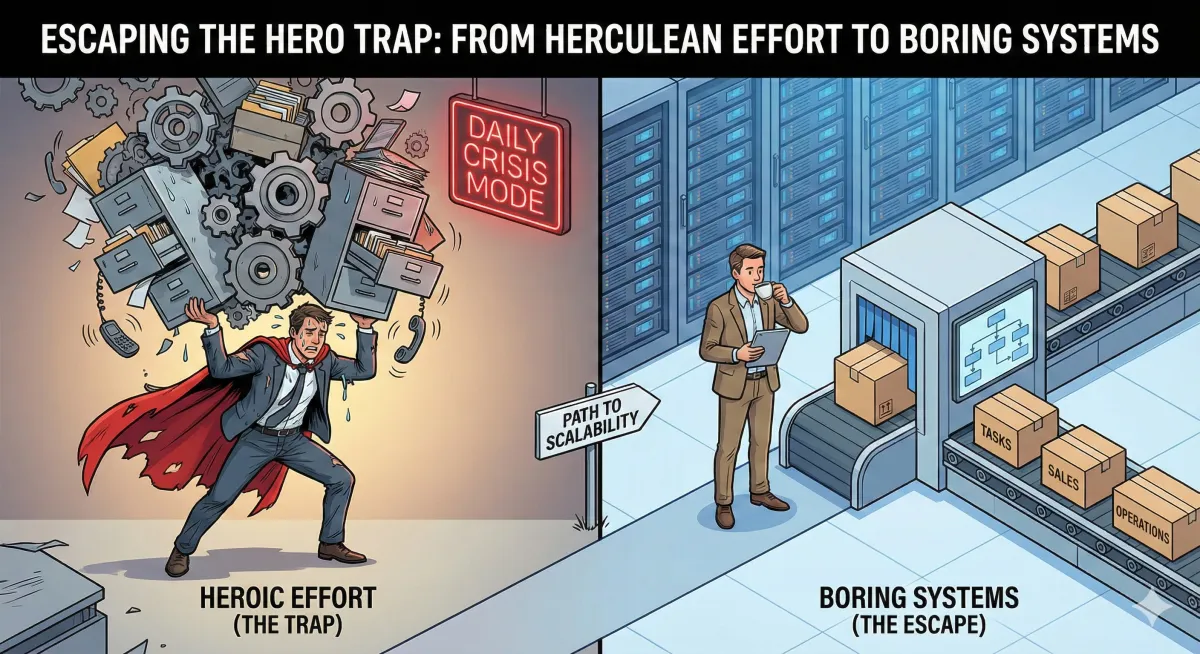
Escaping the "Hero Trap": Moving from Herculean Effort to Boring Systems
Stop Saving the Day: Why Heroic Leaders Kill Scalable Businesses.
If your business requires your constant intervention to survive, you haven't built a business; you've built a high-stress job.
There is an addictive quality to early-stage entrepreneurship. You are the rainmaker, the firefighter, and the visionary. Every problem that arises is solved by your sheer force of will and Herculean effort. It feels good to be needed. It feeds the ego to be the only one with the answer.
We call this the "Hero Trap."
The skills required to start a business (hustle, gut instinct, individual heroics) are the exact opposite of the skills required to scale a business (patience, delegation, systems thinking).
If you feel overwhelmed, constantly putting out fires that you thought you already extinguished, it’s because you are relying on personality rather than process. You are addicted to being the hero, and your business is suffering for it.
The Introspection: Why Do You Need to Be Needed?
Deep down, many leaders resist systematizing because they fear irrelevance. If the sales team can close deals without your magic touch, if operations run smoothly without your frantic Tuesday morning intervention—what is your role?
This is a dangerous comfort zone. A scalable leader's role shifts from "doing the work" to "curating the culture" and "refining the machine."
Moving from Personality to Process
To escape the Hero Trap, you must begin valuing "boring" consistency over exciting saves.
1. Identify "Repeater" Problems
If you solve the same problem more than three times, it is no longer a problem; it is a symptom of a missing process. Don't just fix the error; build the checklist that prevents the error from ever happening again.
2. The "Hit by a Bus" Standard
Look at your critical revenue-generating processes. If your top salesperson—or you—got hit by a bus tomorrow, would revenue stop? If the answer is yes, your process is dangerously fragile. Knowledge must belong to the company, not individuals.
3. Define Guardrails, Not Just Goals
Leaders often give a goal (e.g., "$1M in sales this quarter") but fail to define the guardrails (the approved methods, pricing structures, and ethical boundaries to get there). Without guardrails, your team constantly returns to you for permission. Define the boundaries, and empower them to run freely within them.
The Rocket Sales Challenge
Find one task you perform weekly that you secretly enjoy because it makes you feel important, but that is far below your pay grade as a leader. Document exactly how to do it, delegate it to someone else, and refuse to take it back when they struggle the first time. https://rocketsales.us


