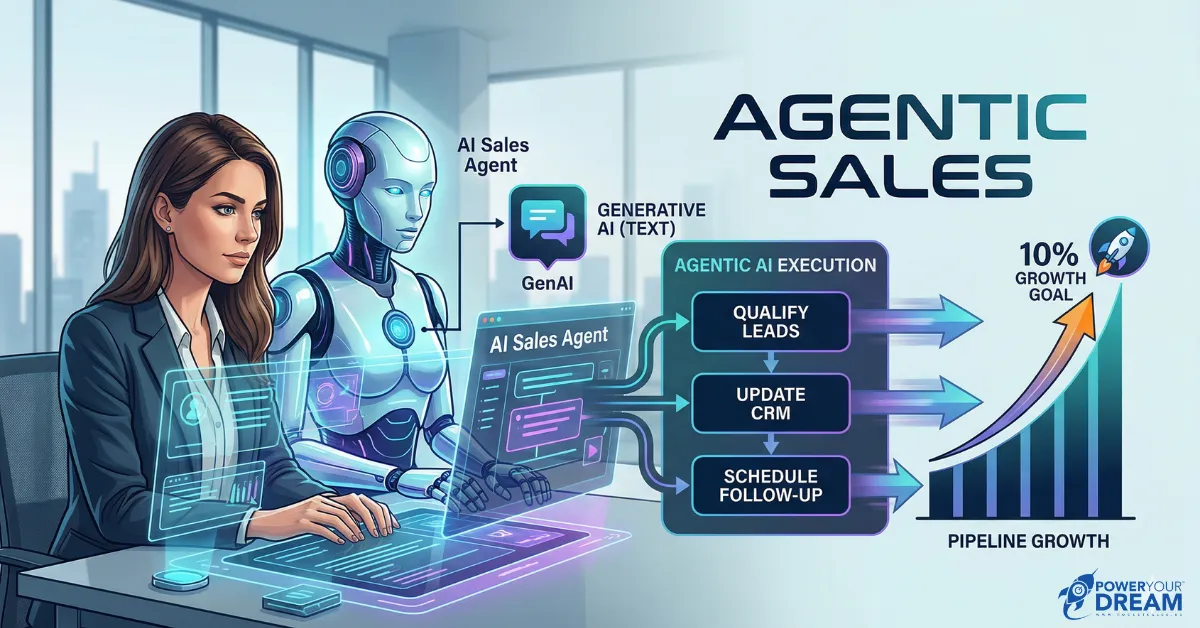
Beyond the Chatbot: Why 2026 is the Year of “Agentic Sales”
For the past three years, the business world has been obsessed with Generative AI. We’ve all seen the LinkedIn posts about how to write the perfect prompt and watched as LLMs became the standard for drafting emails and summarizing meetings. But as we move further into 2026, a quiet but profound shift is occurring. The "Chatbot Era" is ending, and the "Agentic Era" has begun.
For the modern business owner, this distinction is the difference between a tool that helps you work and a system that works for you.
From Generation to Execution
To understand why this matters for your bottom line, we have to look at the limitations of standard AI. Generative AI is reactive; it waits for a human to give it a command, produces a result, and then stops. It is essentially a high-speed intern.
Agentic AI, however, is proactive. These systems—often called "AI Agents"—are designed with goals rather than just tasks. If you tell an agentic system, "Grow our pipeline by 10% this month," it doesn't just draft a marketing email. It analyzes your CRM, identifies high-propensity leads based on current market shifts, researches the latest news about those prospects, crafts personalized outreach, and—most importantly—schedules the follow-up if it doesn't hear back.
Why 2026 is the Tipping Point
In 2024 and 2025, agentic workflows were experimental and prone to "hallucinations" that could derail a sales cycle. By 2026, the underlying models have become stable enough to handle autonomous decision-making. We are seeing a convergence of three factors:
Contextual Memory: Agents now "remember" past interactions across different platforms, ensuring a seamless customer experience.
Tool Use: AI can now navigate your software stack—opening your CRM, checking your calendar, and even interacting with your billing software.
Self-Correction: Modern agents can "double-check" their own work against your brand guidelines before hitting send.
The Impact on Your Sales Team
For many business owners, the fear is that "Agentic Sales" means replacing humans. At Rocket Sales, we see it differently. By delegating the "mechanical" parts of sales—prospecting, data entry, and initial qualification—to autonomous agents, your human sales stars are freed up for what they do best: building trust and closing complex deals. In a world where every inbox is flooded with AI-generated noise, the human touch has become a premium luxury. Agentic AI handles the quantity so your team can focus on the quality. It’s about moving from a "high-volume, low-conversion" model to a "high-precision, high-humanity" model.
Strategies for the Transition
If you want to lead your market in 2026, you cannot wait for these tools to become "standard." You must be an early adopter.
Audit Your Workflow: Identify the "repetitive loops" in your sales process. These are the first candidates for agentic automation.
Focus on Data Cleanliness: An agent is only as good as the data it accesses. If your CRM is a mess, your AI will be too.
Define Your Guardrails: Autonomy requires trust. Establish clear rules for what an agent can and cannot do without human approval.
The goal isn’t to build a business run by machines; it’s to build a business where your people are empowered by them. At Rocket Sales, we specialize in building the bridge between your current operations and the agentic future.